1)You’re lying in bed, exhausted — but your brain won’t shut up.
2) You keep replaying that one awkward sentence from earlier. You wonder if that message you sent sounded off. You plan what you’re going to say tomorrow, how you’ll say it — then rethink it all over again.
3) You’re not trying to overthink. You Y“I think this is just how my brain works.”
4) That thought has probably crossed your mind more than once. And honestly, it makes sense — when you’ve been stuck in a mental loop for long enough, it starts to feel like it’s just who you are.
But it isn’t.
5) You weren’t born with an overYour brain didn’t always work like this. At some point, overthinking became a way to deal with uncertainty — maybe to avoid mistakes, maybe to feel safer. Over time, it just became the default.
6) But just because it’s familiar doesn’t mean it’s permanent.
7) And no, it’s not easy to undo. But with a bit of patience and practice, it can shift — one step at a time.e you’ve picked up over time.
8) 👉 And like any habit, it can be unlearned — not instantly, but gradually, intentionally.
9) In this article, you’ll learn why overthinking sticks around, what it actually does to your mind, and how to break free from its grip — without needing to become someone else.
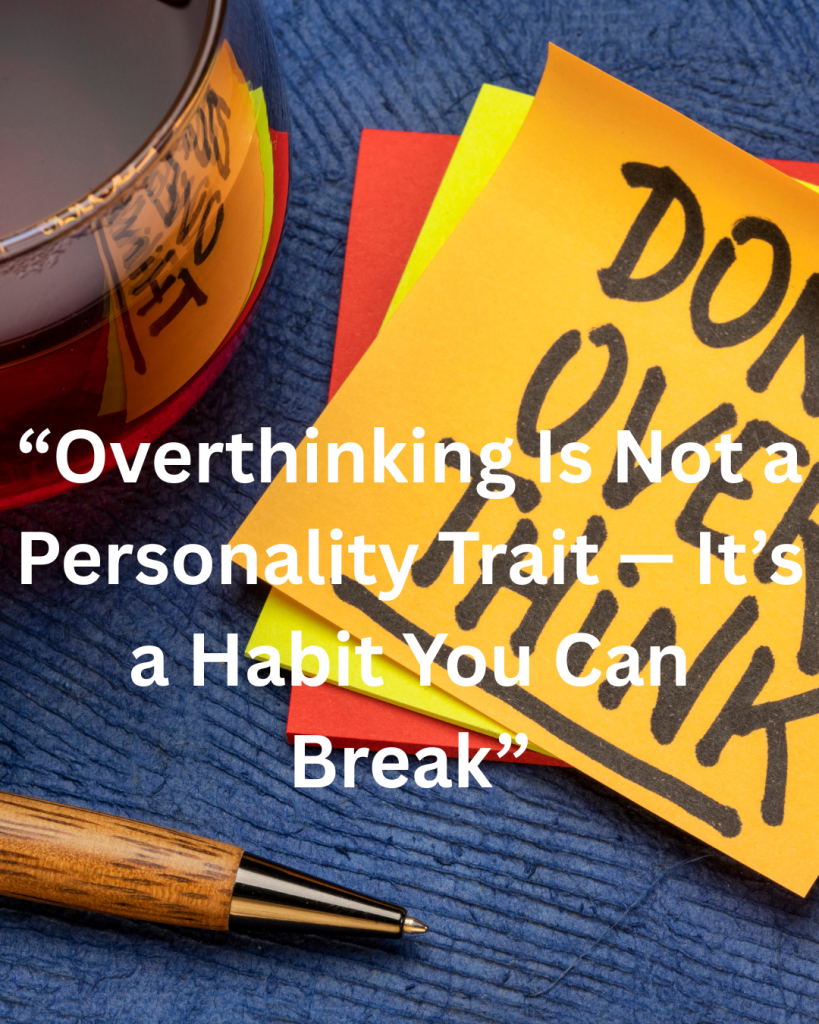
1. Why Overthinking Feels So Personal
Overthinking doesn’t just make your brain busy — it makes you feel broken.
You mother people seem to make decisions without all the second-guessing. They say what’s on their mind and move on. They sleep. Meanwhile, you’re lying there going over every little thing in your head — what you said, how you said it, what they might have thought.
It starts to get under your skin. You don’t just notice the overthinking — you start to believe this is just who you are.
You tell yourself things like:
- “I’ve always been this way.”
- “Maybe I’m just wired differently.”
- “Other people don’t obsess like this… What’s wrong with me?”
- When those thoughts show up enough times, it stops feeling like a habit and starts feeling like your identity. But that doesn’t mean it has to stay that way. people don’t do this. Something must be wrong with me.”
But here’s the truth: overthinking is something you learned to do. Often to cope. Sometimes to protect yourself.
It probably started with good intentions — to avoid mistakes, embarrassment, or being caught off guard.
But over time, that protective reflex became a pattern… and the pattern became automatic.
And here’s the real breakthrough: If your brain learned to do this, it can also learn to do something different.
2. What’s Really Going On When You Overthink
Your brain craves certainty. It wants to protect you from discomfort — emotional, physical, social, all of it.
So when it doesn’t have enough information, it fills in the blanks. It spins up scenarios. It replays conversations. It searches for the “right” way to act or respond — because if you get it right, maybe nothing bad will happen.
To your brain, overthinking feels helpful. It feels like preparation.
But in reality, it does the opposite. It wears you down. You end up mentally exhausted and emotionally stuck — still unsure, still anxious, and often no closer to a solution.
Even worse? The more you overthink, the more you reinforce that loop in your mind. Your brain says:
“This is what we do when we’re uncertain — we spiral.”
That’s how habits work. Repetition makes them stick.
3. How Overthinking Becomes a Mental Loop
Let’s look at how this cycle actually works:
- Something triggers uncertainty – a delayed reply, a strange look, a difficult choice.
- Your brain tries to solve it by running all the angles.
- You feel anxious, so you dig deeper — just in case you’ve missed something.
- The thoughts keep coming, and now you’re even more anxious.
- So you keep thinking. And thinking.
This loop can run for minutes, hours, even days. Not because you want to — but because your brain thinks it’s keeping you safe.
It’s the same mechanism that makes you instinctively pull your hand away from heat. Except instead of a physical danger, it’s reacting to emotional discomfort — rejection, embarrassment, uncertainty.
And here’s the key: you won’t break the loop by thinking your way out of it. You have to interrupt it with action — even a small one.
4. How to Break the Cycle (Without Trying to Force It)
You don’t need to silence your brain. You just need to steer it.
Here are some gentle, real-world ways to break out of the overthinking loop:
🧠 Call it out
Instead of getting swept into the spiral, simply say (in your head or out loud):
“I’m overthinking right now.”
That moment of awareness alone creates space between you and the thought.
✍️ Write one thought down — just one
Pick the loudest thought in your head and write it down. That act alone — of putting it into words — slows the spiral and makes the worry feel more manageable.
🧾 Try a “fact vs story” check
Draw two columns. On the left, list what you know for sure. On the right, what you’re guessing or assuming.
This helps cut through the mental noise and bring you back to reality.
🚶♀️ Do something small with your body
Your mind wants control. But sometimes, your body has the answer.
Get up. Stretch. Step outside. Clean the counter.
Movement shifts your mental state. It doesn’t fix everything — but it helps you step out of the loop.
5. What Overthinkers Often Get Wrong About Action
A lot of overthinkers believe they need to be 100% sure before they act.
You wait for that “perfect clarity” moment — where everything makes sense, the risk is gone, and your confidence magically reappears.
But that moment rarely comes.
In fact, it’s often taking action that creates clarity — not the other way around.
Try this instead:
- Do one small thing that moves you forward, even if it’s imperfect.
- Let the action teach you something — instead of trying to predict every outcome.
It won’t feel perfect. You might still feel uncertain. But action breaks the mental loop in a way thinking never can.
And the truth? Even if you “get it wrong,” you’ll learn more from doing than from endlessly analysing.
6. Final Thoughts: You’re Not Your Thoughts
Overthinking feels personal. But it’s not who you are.
It’s a habit. A deeply practised, well-rehearsed mental loop. And you’ve probably been doing it for years without even noticing.
But you can notice now. And that’s where things start to change.
Every time you interrupt the loop — even slightly — you teach your brain a new response.
Every time you choose action over rumination, you build a different path.
It won’t be insta✅ Humanised Rewrite:
It won’t change overnight. And yeah, some days will be harder than others. But even slow progress is still progress.
Next time you notice your thoughts spinning out, try not to beat yourself up for it. Just notice it. Take a breath. Ask yourself something simple — what tiny thing could I do right now that might help me feel a little less stuck?
It doesn’t need to be perfect. It just needs to be real.
Leave a Reply